
Koans explained with normal words, part 1
Shuzan's short staff, facts, and reality

A post by @bashu_thanks on Xwitter:
a lot of meditation advice is unfortunately like if a guy learnt how to think in Japanese and was like "wow I should write a book so that everybody can learn to think in Japanese" and of course he writes it in Japanese
It’s funny because it’s true. Meditation—or what others call contemplative practices—produces shifts in experience that resist being captured in words, yet words are all we have.
Someone that has never tried spicy food would not be able to truly understand spiciness, no matter how vividly their friends describe the heat or pleasurable pain. That is, some things are experiential and have to be experienced.
When we only know something through words and then try it for real, all the prior descriptions usually snap into place, not because the words were inherently right, but because now they have something real to anchor them.
A lot of meditation advice are specific instructions: sit this way, breathe like this, focus on that, or sometimes confusing stuff like “there is nothing that needs to be changed, EVERYTHING IS PERFECT!” because what they’re pointing to isn’t in the instructions.
The words are trying to describe experiences that aren’t words. Which brings us to Zen koans. I love them. Strange, finicky puzzles that seem to say one thing and mean another—or maybe mean exactly what they say. Some have said that koans are difficult to grasp with conventional thinking, but I don’t think so: conventional thinking is enough, and so are conventional words.
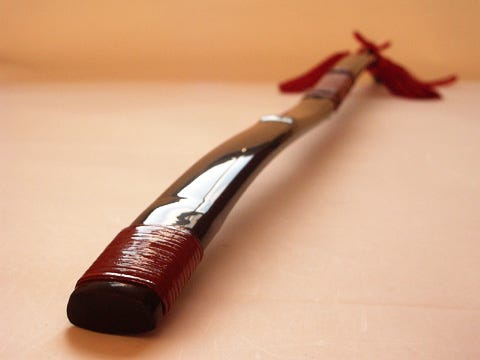
a real short staff
Shuzan held out his short staff and said:
“If you call this a short staff, you oppose its reality. If you do not call it a short staff, you ignore the fact.
Now what do you wish to call this?”
There’s a difference between fact and reality.
Reality: the staff is atoms arranged in cellulose chains, lignin matrices, and trace minerals. Wood cells stacked in complex patterns. Add in a sentence or two about badly written quantum mechanics, and voila! The reality of the staff is that of irreducibly complex things, unable to be named in any particular way because they are subatomic perturbations at the same time it is tubular wood.
There’s a Borges character named Funes the Memorious that was cursed with perfect memory and an inability to do abstractions. His dog at 3:14 PM wasn’t the same as his dog at 3:15 PM because to him those dogs are in different positions, has different shapes as reflected in his eyes, and are thus different beings.
For Funes, Shuzan’s staff is not just a “short staff” but as the exact arrangement of every fiber, every scratch, every shifting shadow cast upon it in its particular instant-of-instants; never the same staff twice. To name it as “staff” is to erase all that specificity, to overwrite infinity with a single symbolic mark.
We’re luckier, because our minds smooth reality into manageable chunks. “Staff” becomes a useful bucket for wood-shaped things of certain lengths.
“If you do not call it a short staff, you ignore the fact.”
But what about Shuzan’s fact? A fact is that people call it a short staff. A fact is that if you hit someone with it, they will say “Ow!? Why’d ya hit me with a staff!?”
Fact is, words work because we pretend they do, and we all pretend together, so the world moves along just fine. Shuzan’s question is helping us to notice the gap between the map and the territory, between the world as it is and the world as we talk about it, because language lets us carve the raw mess of being into neat, nameable chunks, and that’s useful.
But every name is an incomplete representation, an incomplete reference.
Some people see that words are incomplete references and conclude that reality must be some unspeakable ineffability, forever beyond reach. But the short staff is right there. You can pick it up, you can hike with it or break it into two, make it wear socks, give it to an old man in the park...
But I digress. The most important thing is the koan’s end:
“Now what do you wish to call this?”
Call it a staff, sure. Call it a stick, or a walking aid, or Woody. The important thing isn’t what we call it, but that WE are the one doing the calling. WE are the one performing this ancient magic trick of turning vibrating weirdstuff into meaningful chunks. But therein lies the trick: Because now, we understand that fact and reality is irreconcilable, at least in the symbolic sense: how can something be true at the same time, or neither being true at the same time? But at the same time, clearly irreconcilability is reconcilable in practice. The world doesn’t break!
By asking “what do you wish to call this?”, Shuzan forces us to confront the act of naming, the very thing that creates the gap between fact and reality in the first place.
And naming isn’t just for objects. We name stuff in our head every single day, pretending fact and reality as one and the same, not only in cold clinical comprehension, but also emotionally, spiritually.
Like, for example, memories. They’re not really solid film-like flashback. “My summer in Barcelona” are made out of sensory contrasts—inexpensive seafood and salt air, utter awe in Gothic Quarter alleys, afternoon light hitting beautiful faces—then the bodymind stiched these pieces into something we can talk about, share, and remember.
The fact of memory smooths over reality’s endless gradients.
The self, which is composed of countless memories and our shifting narratives about those memories, are composed of different cognitive processes and different bodily systems, yet somehow “I” feels real and continuous. We say “I was different back then” and “I’ve always been this way” which feels both true, both false. When Shuzan asked now what do you wish to call this, he was asking us to tune our cold clinical comprehension between reality and fact into something more real, that is:
If you do know that there are at least two ways of being, why are you still stuck choosing between fact and reality? Between calling it a staff and not-calling it a staff? The staff is both map and territory, both word and wood, both mindstuff and atomstuff. Our memories are both true and false, our self both continuous and fragmentary, but also neither at the same time. So we’re not necessarily transcending language, but we’re already dancing between these supposed opposites in every moment of life. It’s not an IQ test. He’s pointing at how things already are.
And how we already are are both reality and fact, neither of them, neither both nor neither of them, maybe something else. All we have to do, per Shuzan’s short staff subtext, is to see.
.
.
.