
understanding Emptiness
a short exploration

Most of us don’t wake up each day wondering whether the things around us are as stable or real as they seem.
We go about our lives assuming that abstractions like “Self”, “Objects” or “Meaning” are fixed, reliable concepts, much like those studies that purportedly measure some kind of an objective truth. But sometimes, when life gets complicated or in quiet moments of reflection, we might ask ourselves: What’s really happening around us?
This is where Śūnyatā or Emptiness comes into play. And no, it’s not about religion or nihilism. In fact, it’s the opposite of bleakness. Emptiness is the idea that things don’t have fixed, unchanging cores; everything is interdependent and kind of arbitrary.
Think of it like the sky. Open, vast, always present, making room for everything that appears in it from clouds to sunlight to storms. An emtpy sky is the source of all those possibility.

Whether a banker or a poet, if you’ve ever felt weighed down by rigid concepts—about who we are, how life should be, or what things mean, then understanding Emptiness can be freeing. The theory is that once we realize that things aren’t as fixed as they seem, then the totality of life could be approached with more flexibility, less attachment, and less suffering.
Anyway, to approach this concept, there are 10 “layers” or “strata” of how Emptiness works that will be explained below, each building on the last.
P.S. This is all written in plain language so no complicated philosophical terms are used, nor do people need to convert to anything, but… do avoid mapping it onto existing philosophical traditions. It’s less about learning a concept and more about noticing how our experience of being could manifest moment-to-moment.
Let’s start.
First layer: The map is not the territory
Perceptions, words, and thoughts are abstractions, not the thing itself.
When we encounter something, we experience it through filters—our senses, our language, our thoughts—but those are all representations of the thing, not the thing itself. Representations are not reality.
For example, a recipe for a cake isn’t a cake, a photo of a cake isn’t a cake, the word “cake” isn’t a cake, our memory of a cake isn’t a cake, and even seeing and touching a cake isn’t the same as the cake itself.
The cake might exist as “thing-in-itself” which is a reality beyond what we perceive, which is different from all of our representations. Yes, no matter how detailed or vivid they are. However, in order for civilization to function, we rely on these abstractions to communicate and share ideas. Without them, we wouldn’t be able to talk about anything at all. This process of using abstractions to refer to things is called referencing or reference.

Imagine trying to describe the taste of a mango to someone who has never had one. No matter how much you explain the sweetness or the texture, your words will only be rough approximations. The person might get a general idea, but the actual taste—the real experience of eating the mango—can never be fully conveyed through words or concepts alone. In the same way, everything we perceive and talk about is just references to the real things, and not the thing-in-itself.
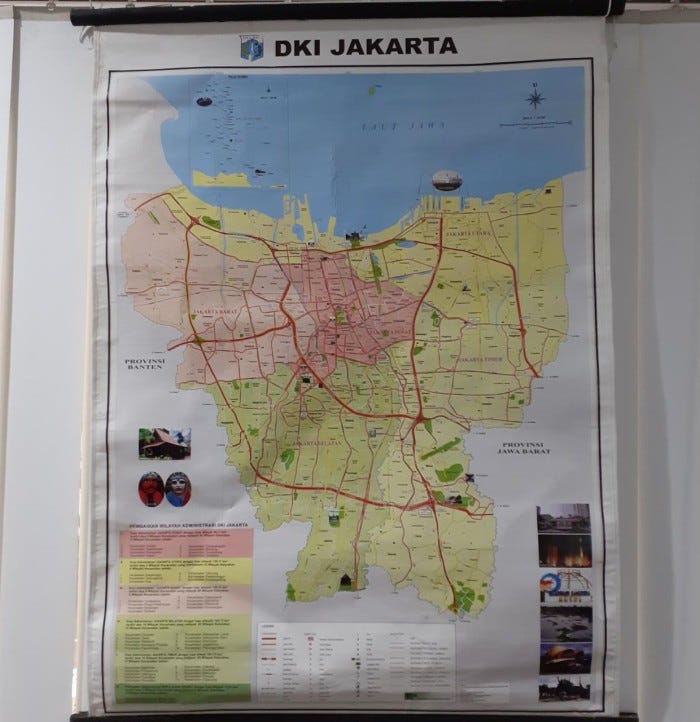
Or imagine about how we interact with maps. The map of a city isn’t the actual city, the actual territory—it’s just a simplified guide. Streets, parks, museums, and landmarks are all represented on paper, but practically no-one mistakes the map for the real thing. The map can help us get somewhere, but it’s not the place itself. In the same way, our thoughts and perceptions guide us through reality, but they aren’t reality itself.
That’s the first layer: The map is not the territory and its somewhat distant cousin, all models are wrong, but some are useful.
Second layer: Abstractions are multimodal
One of the most common abstractions (or map) that we use is language. To simplify, languages are composed of sentences, and then words.
Words aren’t just neutral symbols or conceptual representations, because they can spark emotions, unlock memories, or trigger a desire. This makes them multimodal: A blend of multiple ways of experiencing the world, beyond mere mental images or logical constructs. When we use words, we’re often tapping into several layers at once.
Think of the word “home”; Perhaps your mind is transported to the creak of a loose door hinge, the way sunlight filters through your bedroom window, or lingering voices from yesterday's family dinner. These sensory and emotional associations are part of the word, making it multimodal.

Or take another concept like “coffee”. The word might carry a bitter taste on the tongue, an aroma and temperature of something brewing and perhaps even a blurry, aggregated vague feeling of working in a café.
But this points to something deeper. What we call abstractions, also known as Saṅkhāras, aren’t just mental concepts floating in some imaginary mind-space. They’re the raw stuff of experience itself, the entire spectrum of how reality shows up in/as/on your consciousness.
It’s the feeling of feeling the weight of your body, the sense of “here and now”, the subtle knowing that you’re the one reading this, the almost-unconscious placement of limbs in spacetime, the flicker of thoughts about what comes next, and desire—so many desires—these are abstractions. They’re formations, patterns that arise and pass in your awareness.
Even things like intention (“Oh, I should probably finish this deadline”), knowing that something is of the color red, or the different feelings of crushes that you felt towards people. They’re how experience happens at all. Multimodal patterns constantly birthing what we call “reality”.
So abstractions, in which words are a part of, are multimodal; all sort of things that we experience in our awareness through our lives.
Third layer: Abstractions compound onto themselves
Now here’s where it gets interesting: Abstractions don't just sit there side by side. They actively shape, transform, build upon, and create each other into intricate patterns of experience. This process is called compounding, also known as interdependence. Think of it like waves in the ocean, where each wave both affects and is affected by countless others. Every ripple exists only because of all other ripples, you can't point to where one wave truly begins and another ends. That's interdependence, where nothing exists on its own and everything arises together, and in which some abstractions (feelings, desire, thoughts) can only appear only by way of certain cause and effects. We’ll explore this lataer on.
But for now, focus on compounding. Normally the term exists in a financial context, like interest building up over time. But here, it’s about how each experience, each abstractions and mental (bodymind) formation, can intensify and deepen each other, or crashing to each other and forming a greater whole then breaking up again.
Coming back to the wave metaphor, we can stand on a short cliffside and watch the waves beneath: They pile on top of each other, colliding from different directions, breaking apart, reforming in unpredictable ways. Some parts catch the sunlight that dazzle in sharp flashes and others sink into shadow, turning darker and colder. Between them there are layers of shifting tones, flickering in and out of focus as the currents pull each other beneath and above. It’s not just light and dark, but a swirling mix of forces, each wave not isolated but colliding with countless others. The whole surface constantly churns, stretching and distorting in ways you can never fully track, with seemingly many forces hidden underneath. That’s how abstractions work; they compound onto each other to create an experience.
This compounding isn't happening to pre-existing things, but also how we perceive anything to come to exist. When we look at a “cup”, we’re not perceiving an object and then adding layers of meaning in a deliberate way. The cup emerges through an inseparable dance of light, neural patterns, memories, and intentions. Try to find where pure perception ends and interpretation begins: You can't, because they’ve never been separate, like ocean waves.

If that’s too abstract, picture: A song reaches your ears. but it doesn’t just trigger one single clean memory or thought. Instead, it pulls a mess of things all at once. Fragments of other similar tunes, half-formed thoughts, fleeting images, and maybe some sort of melancholy. Suddenly, the song is not just the song per se—we’re inside a swirling mess of associations, each one twisting the experience in a different direction. The sound isn’t just sound anymore because it has tangled itself with everything else in the bodymind, feeding back, compounding, and creating new layers.
Take a moment now to look at any object near us. Notice how quickly the mind wraps it in labels, intention, the potential use of that object, memories, and meaning, often all at once and without much differentiation.
This reveals the dual nature of abstractions: They're multimodal, which is about having different types of nature, and compounding (interdependent), which is about building upon themselves to create our moment-to-moment reality.
Fourth layer: Abstractions create meaning so meaning is also compounded, but more importantly they are relational
What counts as meaning is hard to pin down, but abstractions usually create a sense of meaning, whether strictly semantically or otherwise.
What’s important is this: Meaning doesn’t exist in a single word. Instead, it arises from how words interact with other abstractions—sensations, memories, and emotions.
Meaning isn't a thing we can point to or touch, because it’s more like a tangled web of significance. Think of how a wedding ring becomes meaningful. It’s not just a band of metal, but rather a promise of future memories, loyalty, and shared values with a certain loved one. A layered meaning emerges from these connections, not from the object itself.
In other words, meaning isn’t a property that exists in things by themselves. Instead, it blooms from how abstractions can layer, compound, and interweave with our lived experience. This is called relationality, or its adjective form, relational. When people speak of something being “meaningful”, they're recognizing these deep networks of connection all at once, even though they're built from countless small, subjective moments and associations.
People speak of “meaning” as if it has an inherent existence or as if it is a property that exists in things, like a physical trait that we can point out or find in the very end of our lives. It’s not. When people say that “life has no meaning”, it is not necessarily a logically and experientially coherent statement.
Again, imagine a family heirloom. To a person, a ring from her grandfather might just be a piece of meaningnless metal but to another, it might carry the weight of generations, memories, or the feeling of a special lasting connection. The ring itself hasn’t changed—it’s just some metal—but the meaning it holds comes from the layered, relational associations you’ve built over time.
In other words, meaning is relational—it emerges from how abstractions can connect and compound with our personal experiences, which are also abstractions in and of themselves.
Fifth layer: Meaning and abstractions are arbitrary, and therefore so is reality
A consequence of abstractions not standing on their own (relational) is that they also get their meaning in relation to other abstractions, like words and thoughts, and that means that essentially everything is arbitrary.
What is “arbitrary”? Merriam-webster says “existing or coming about seemingly at random or by chance”, but in this context, it means that everything is woven from nothing; reality is spun from meanings that exist only in relation to each other, neither grounded nor cosmologically absolute.
In terms of meaning and abstraction, arbitrariness means we live in a semantic mirage. What we think as “reality” itself is constructed from relational, interdependent, and compounded impressions (abstractions), none of which inherently “point” to anything essential.
“But surely there is reality. I can point out to an apple and that apple is still an apple!”
Well, that’s why in the second and third layer, we’ve established that abstractions are not just about meaning or references, but the very mental—bodymind—processes that human beings have. To reword it in another way:
Abstractions are not just words, concepts, or ideas that float in our minds. Abstractions, or also known as Saṅkhāras, are the entire range of bodymind formations that shape our perception of reality—thoughts, sensations, memories, emotions, desire, and other constructs. Every moment of experience is made up of hundreds contiguous abstractions.
Take the word “hand” and the letter h-a-n-d. It seems to point directly to this thing at the end of our arm. But why? There's nothing inherent in those sounds or symbols that connects to the bare flesh and bone. It works only because it fits into a web of other concepts like body, grasp, touch, or self. As in, what makes us see a “hand” as a distinct thing at all? We artificially draw this boundary around a constantly changing process of cells, sensations, and movements. A hand, if you really think about it, is really just energy and matter flowing through a temporary form we’ve decided to label. It doesn’t mean that the label is meaningless, but it does mean that meaning is phenomenologically arbitrary.
The word “hand”, when spoken or written, only makes sense because it connects to a whole web of other words like body, self, or fingers. Without that web, “hand” is just an empty sound, meaningless on its own. Taken even further, the abstraction of knowing that “this is a hand” only makes sense because we have a string of unbroken unconscious definition like “hands are articulated joints that is grafted to a trunk-shaped skinflesh cylinder which is then grafted to an even larger one”, and so every abstraction depends on the others to make sense—again, relational and interdependent.
So far, this sounds like a standard postmodern deconstruction of words and concepts. But here’s where things get weirder.
Consider: Humans see color and shapes in a different way than a dragonfly. A dragonfly sees in ultraviolet, processes images at nearly 200 frames per second, and has compound eyes that create a completely different way of spatial parsing.
So what we call “seeing an object” isn't just different for a dragonfly, because the very notion of “object” might not apply. Their compound eyes create a way of parsing reality that could make our concept of reality to be very different. We say they “see in ultraviolet” but that's like saying a bat “sees with sound” because we’re just mapping our categories onto fundamentally different ways of being. It’s like those number jokes in which an alien with a different base-number system misunderstands something we take for granted.
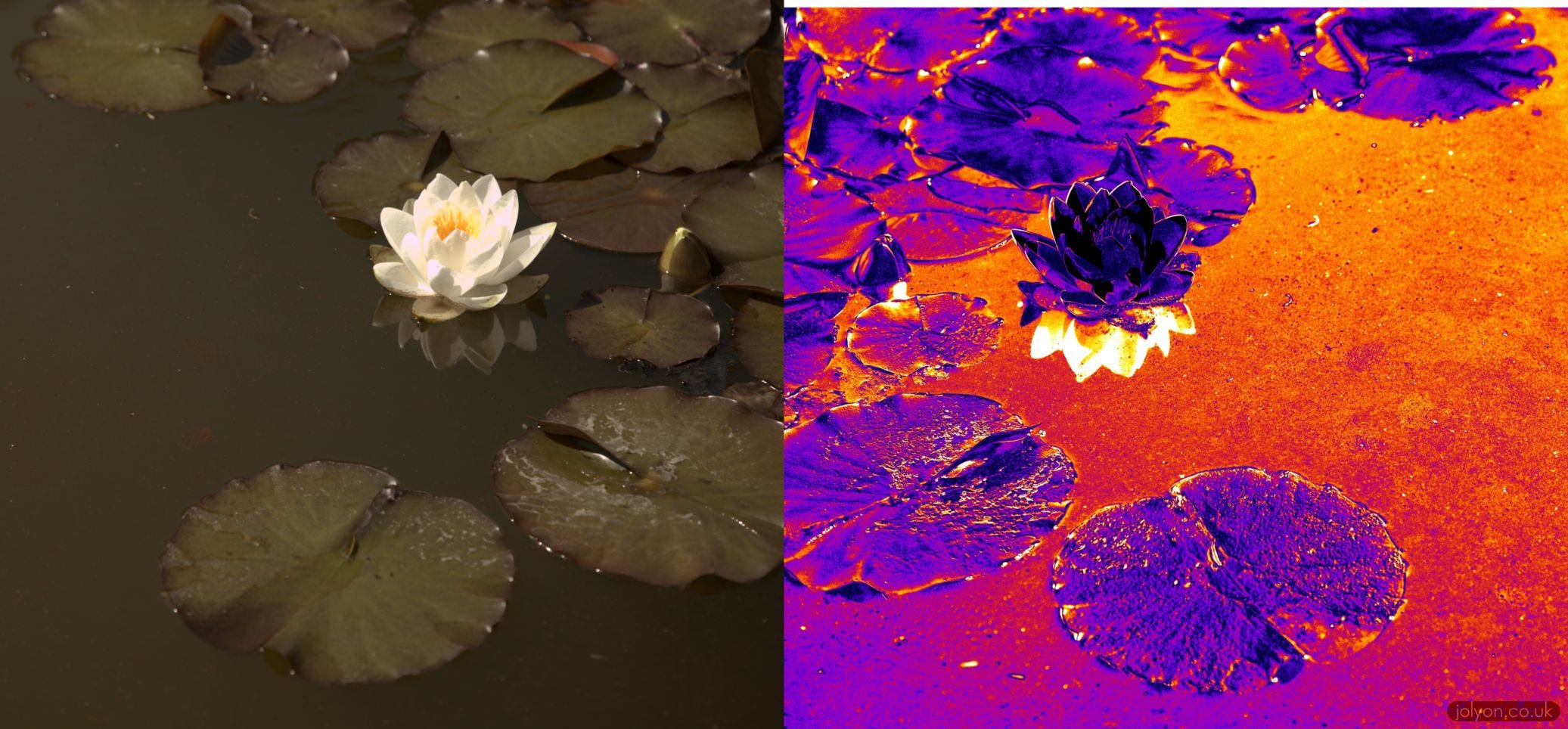
So even basic sensations like “red” aren't fixed. Other than dragonflies, well, bats build worlds from sound waves, and an octopus might feel color through their skin. Our whole way of carving up reality by way of objects, colors, and actions comes from the specific architecture of our nervous systems. Different beings, different worlds.
This extends beyond sensory differences. The way we parse reality into discrete “objects” is also arbitrary. When we see a “tree”, we're drawing boundaries around complex processes that’s continuously exchanging matter and energy with its environment through roots, leaves, and microorganisms.
In other words, seeing a “red apple” involves multiple compounding layers of abstractions. The visual sensation itself, the instinct of what counts as “red”, memories of other apples and how are they different from this one, expectations of taste (which is different from the taste of that apple itself), knowledge about nutrition, etc.
So that we consider as a direct seeing experience is actually a multimodal, compounded relational interplay (see: dependent origination) of these abstractions. There might be no “pure” sensation or thought that exists independently of this tangled, continuous web.
As science progresses, we come to understand several other arbitrary abstractions that we can then identify, for example:
The separation between an abstraction known as “experiencing” and an abstraction known as “remembering” is arbitrary, because “real-time experience” is actually collection of sense-data from the eyes, ears, and other organs that then get processed in the brain and experienced through an infinitesimal delay that we don't notice.
What we consider as the duality between “one action” versus “many actions” is arbitrary. When you “lift a cup”, where exactly does the action begin? With the intention? The first muscle movement? The neural firing? And where does it end? And thus, an abstraction known as “discreteness” is arbitrary.
The distinction between “physical pain” and “emotional pain” isn't that clear-cut. Pain activate overlapping neural networks and can transform into each other, and is subject to many other factors still.
Each of us have a different definition or a different abstraction of what constitutes a “decision”, but when we “choose what to eat”, where is the actual choice? Where is the object called “choice” in itself in reality? In the nigh-immediate conscious selection? The unconscious craving? The gut bacteria influencing cravings? The social conditions that has determined your available options? The evolutionary pressures that shaped your preferences? The action, or the intention? The moment the choice starts, or when the choice ends? These are not mere theories, but to illustrate that an abstraction known as “choice” doesn’t really exist in reality as-is, except as a set of abstractions that are arbitrarily compounded with other abstractions.
Sixth layer: Arbitrariness itself is arbitrary
This is not a postmodern theory, but something to be experienced: “Arbitrariness” itself is a word or a concept, and words and concepts are, too, an abstraction. In fact, I’m getting tired of saying “abstractions”. Some of you might feel like something is not right about how we use “abstractions”, “arbitrary”, “interdependent”, or “relational”, but it is normal to feel that way. Why?
Because arbitrariness itself is a compounded and relational (interdependent) abstraction: Its formal definition is that of a word that is associated with randomness, a lack of inherent order, an absence of necessity and meaning—but these associations themselves are arbitrary! What we consider as “random” versus “ordered” is itself an arbitrary distinction or an arbitrary duality that we impose on reality.
When we say that something is “arbitrary”, we might be implying that it could have been different, that it could take another form, but this very notion of “could have been different” depends on our, well, arbitrary way of parsing possibility and actuality, which is just another arbitrary distinction.
Even our instinct that some things are somehow “more arbitrary” than others is itself arbitrary. We might feel that the word “hand” given the previous sections is more arbitrary than the experience of seeing a hand in reality, but this hierarchy of arbitrariness is just another arbitrary distinction. Taken further, an abstraction that we might know as a bundle of feeling or a mathematical logic implying that something is “more” or “less” than something else is, as you can already guess, arbitary, even if the mathematicians object to this.
Seventh layer: “Sense of self” is also relational, interdependent, compounded, and arbitrary.
Like other abstractions, we now know that there is a sense of “self” that we experience as a bundled, developmental thing (babies don’t have them).
Obviously, this sense of “self” differs for people. Each person experiences an idiosyncratic sense of self that is composed of memories, sensations, thoughts, emotions, stories, social roles, beliefs—which we can also call as abstractions—all arbitrarily bundled together into what we experience as “me”. Me as in “I am”, as in “My name is…”, as in “I remember what has happened from twenty years ago and all that has made me the person that I am.”
However it is experienced, it’s also obvious that the boundary and the definition for this “sense of self” are more blurry than it first appears. Consider, for example:
The distinction between the feeling of being “the one who experiences” versus “what is being experienced”, because when you're aware of your breath, what exactly is aware of what? Where is the boundary between the awareness and the breathing? Does the awareness arise before the breath, with the breath, through the breath, or because of the breath? Thus, the feeling of “I am aware of…” might be also be an arbitrary distinction—it could also be relational, interdependent, compounded, and arbitrary, rather than clearly divided into “subject” and “object”.
The distinction between “self” and “others”, because think about how your identity shifts depending on context. At work, we might feel like a professional with certain social roles while at home, we’re a parent, a sibling, or a partner. In a conversation with a close friend, I might feel more of “myself”, yet the sense of self I bring to that interaction is shaped by the relationship itself. The sense of “who I am” isn’t an isolated, independent entity, rather, it is continuously influenced by and contingent upon the interactions with other people around. And so when does “I” end and “others” begin? When do your, my, our actions stop being “yours, mine, ours” and become part of a shared flowing interaction in reality? Thus, this boundary is more fluid than we often assume.
And then consider the distinction between body and mind—where does the physical self end, and where does the mental self begin? We think of “I” as something inside the mind, while the body is a vehicle for that “I”, but the more I look at it, the more you see that what happens in the mind is deeply connected to the body. Take a moment—notice how emotions stir and arise in the gut or the chest, how thoughts seem to arise not from an isolated mind but from the sensations in the body itself. Is it really true that “I” exist mostly in the head, while the body is something that the “I” somehow “have”? Or are they intertwined, inseparable, part of one seamless process and experience?
Furthermore, what about the continuity of the self? We feel as though “I” persists from moment to moment, but this continuity is an assumption. Look closely at each moment, look very closely, feel the weight of time—each thought, each sensation, each feeling. Are they really the same from one moment to the next, are there series of flickering moments, constantly arising and ceasing away? Memories, emotions, desires, thoughts—the “you” that began reading this sentence is not quite the same “you” that finishes it. Even as you read, even as we feel, I’m changing. So where, exactly, is this continuous self in reality? This is not theoritical: Can you find that whole self, existing in reality? Can you understand or feel it without using words?
You might have noticed already but at a certain point the words I, you, and we are used somewhat interchangeably, and that points out to something important: That the abstractions known or felt as the flow of consciousness or as awareness, as the sense of “I”, are not necessarily the only default in which I can experience the world, or of the world experiencing me. Awareness is awareness but it is not permanent, nor incorrectly assumed to has only one form. It is a shifting, interdependent, relational, compounded abstraction that interact with other abstractions and with reality itself; a totality of being that is transient, beautiful, and colorful—insofar as it could be coarsely and partially described as those adjectives in particular.
And so there is a sense of self, but it is a sense of self that is subject to relational, arbitrary, and compounded interdependency as any other abstractions. In this knowledge, hopefully, comes freedom.
Seventh-and-a-half-layer: More elaboration
This part is optional and can be skipped, but in here I will elaborate so that the inferential gap between the seventh and the eight layer is smaller.
Let’s look closer at what we call “perception”.
We say “I see a cup”, but what is actually happening in that moment of seeing?
Before thought (or mental conceptions, or abstractions, however you want to name it) carves the moment into “I, the seer” and “cup, the seen”, there's just seeing happening. Try it now; look at any object nearby. In the immediate moment of perception, before the mind splits it into subject and object, can you find where “you” ends and the “seeing” begins? Where seeing ends and the “object” starts?
Or the processes of hearing. When a sound occurs, we quickly label it as “I am hearing a bird” but in the actual moment of hearing, before thought divides everything up, where is the “I” that hears? Where is the separation between the hearing and the sound?
This is to say: What if there isn’t actually a an experiential gap between the experience and the experiencer? What if that division is itself just another arbitrary and compounded reference point that we have taken for granted?
Eighth layer: Referencelessness
So what happens when we really get that there’s no separation between the perceiver and the perceived? Between experience and the experiencer? Again, all this is not an intellectual understanding, but a direct recognition: Awareness or experience isn't something that happens to things, but it’s what your reality is doing.
At this point, the gap between what is regarded as “inner” and “outer” should collapse. Look right now—before we parse these words into the abstraction called “I am reading words”, there's just… this. Reading. The experience of reading. Thoughts. Again, the map is not the territory.
Before the bodymind draws its familiar conceptual boundaries, which we then call as abstractions, and before the bodymind bestow meaning to those abstractions, experience just flows without reference points. There isn’t even a subject or object, but reality knowing itself through these eyes, these thoughts, these sensations. A taste arises but before it becomes “I am tasting me tasting the salt in this restaurant”, there's just… tasting. A thought appears, but before it becomes “my thought, which I have deliberately thought about”, there's just thinking happening. Emotions surge and fade like waves, but they're not happening to anyone, they’re a shape of experience. Even what we call “time” and “space” are reference points that the bodymind adds later. It is not mystical, special, or philosophical, but more ordinary than ordinary. This isn't about achieving some special state. It's about recognizing what's already here when we stop trying to stand outside experience and just let it be what it is.
But here’s the trick: The reference points and the abstractions and the meaning can still arise, they are part of being human, but they’re like clouds and refractions in a clear sky. How would that feels like? It would feel like Awareness knowing itself, not as subject or object, not both, not neither of them, but as far as words go: An unbroken expanse where experience happens;
Vivid being;
Thought arising as neural cascades in the bodymind, flashes of energy through a network, known and unknown at once;
Something flowing through time and generations—genes, traits, and behaviors shifting as they adapt, life expressing itself;
A stretch and a pull, a tension and then a motion to relax, I go to work and create another slide, you have accomplished much and we are so proud of you, numbers and letters strewn around and rotating endlessly, brown mottled leaves, your hand in the cool water—ripples spreading outward, edges forming and dissolving, and love, always love, of mothers and families;
To make our own stories, to love without knowing why, to forgive without needing to or even with resentment still deep within, to feel joy for no reason, to rest, to act, to change, to stay still—each of these allowed, none of them required;
To care for loved ones, to be responsible without needing to or without carrying the weight of an abstraction called responsibility, to be free in choosing things that can limit our freedom;
To understand that the utter totality of being-ness is fluid but also selective, and that we can choose, because they shift depending on the angle of the light, the mood of the moment, and the stories that we tell ourselves about them;
To recognize that Form and Emptiness are playing the same game, and we’ve been playing it too, all along;
To simply be without exceptions.
Ninth layer: Emptiness
These abstractions, words, layers, distinctions, meanings, and arbitrariness—everything from “self” to “choice,” from “perception” to “language”—are essentially arbitrary, but they don't necessarily need to be undone, fixed, or improved. They can be Seen for what they are: Relative, shifting, empty of inherent essence, insofar as the word known as “essence” could convey what I wanted to communicate. This is the definition, if there is ever one, of Emptiness.
Emptiness doesn’t mean nothing—it might mean no-thingness, that there isn’t necessarily a thing-in-itself, or if there is, we don’t really know what it looks like in reality, or whether that very concept of knowing even holds water. If there isn’t a thing, then everything, or most things, or some things, arise in a flowing interdependent compounded dance, and yet none of them have a fixed, self-contained core that could be pointed and isolated at from the perspective of a human being. This recognition isn’t a negation but an opening, an invitation to what I think to be “places” and “conditions” of less suffering and expansiveness and hopefully, play.
In simpler terms: When we say something is “empty” we don't mean it doesn’t exist at all. Rather, it means it exists in a way that’s categorically different from how we usually think about existence, which is with words and concepts and, well, abstractions. Instead of being a solid, conceptually and experientially separate “thing” with its own independent nature, everything arises (and ceases) #together.
This is what with Śūnyatā or Emptiness is trying to point out: Not nothingness, but the spacious, open nature of reality that are more like ripples in a vast ocean, distinct but not separate, always flowing and changing in many particular ways. It’s not some gooey “everything is just vibes”, because physics exist and is real, but more like what is our emotional and existential stance to reality? This is what we’ve been circling around with all the talk of arbitrariness.
Now at this point, some boundaries that once seemed critical, the distinctions that once felt vital to uphold, should be able to begin to dissolve like sugar in water, melting into the fluid, shifting experience of life itself. It’s less like living in an isolated dot on the map and more like realizing that we are the space itself in which the map exists. Everything flows through, and yet I/you are none of it, and yet you are a self that has a coherent and great story, and yet you are also the world experiencing itself from some eyes, and yet you are beyond it all, and yet you are and not aren’t. How joyous!
To be something, to achieve something, to define the self, to figure it all out—they might be meaningful, but maybe they aren’t. Letting go of the limits of language might mean to let Form and Emptiness play their parts, where each moment arises and ceases with less reactive judgement. Less about standing outside of life and trying to make sense of it from a fixed vantage point and more in it, is it, with nothing to truly lose. We can still do sensemaking or truthseeking, but hopefully some of the conceptual clinging can be lessened in intensity.
In other words, it’s not about making sense of it all. The urge to “find meaning” might dissolve into a quieter knowing—that whatever we call “self”, “truth”, or “life” is not something to pin down or possess but to simply be, unfolding into an understanding that might or might not transcends language. After all, life doesn’t require understanding to be lived, nor does awareness need a reference point to exist, as per the previous layers. Letting go of the need for fixed definitions (Emptiness), we’re left with a boundless space where everything can play out in whatever form it arises. If there’s anything to “conclude”, perhaps it’s this: To witness, to allow, and to participate, and to be aware that Form and Emptiness, Self and others, even knowing and unknowing, are all part of the same dance, made out of the same reality-stuff.
In practical terms, think of it like this: We’ve been using a map (called language and writing) to understand the territory called reality. We’ve seen and dissected how the map is made, how its symbols work, how it relates to other maps. But at some point, we need to look up from the map and see the actual landscape. And that landscape, the immediate, flowing reality of experience—can’t and should not be fully captured in the language of maps. And whatever so-called conclusion that you can find there might not be comprehensible to other living beings, and that’s fine.
Tenth layer: Living
Having seen the empty nature of all phenomena, including the concept(s) of Emptiness itself, how does life move?
The conceptual bodymind continues its tireless work of planning, remembering, creating stories. The sense of self arises and flows as it needs to, a natural cognitive pattern as essential as any other. Everything—from quarterly reports to the laws of physics, from the feeling of “I” to the various vast spaces of awareness—is reality knowing itself in Forms.
This might be controversial, but there’s no need to privilege nonconceptual awareness over concepts, or Emptiness over Form. A mother calculating her child’s medication dosage is expressing precise measurement, which is good. A programmer debugging code is working through logic, which is good. An actor preparing for his role is—you get the point. The story of who you are and where you’re going is itself narrating itself, and that’s good.
The specificities of of human life are beautiful, and full of horror, and of joy, etc. The precise requirements of my job, the unique dynamics of our relationships, the particular stories that shape your/my/our choices—these aren’t less real or less important than some imagined “ultimate” reality. They’re how themselves manifesting in exactly those forms, those contexts, those moments.
Be free!
Thank you for this, Jati! Such a comprehensive and thoughtful exposition on emptiness. You showed me ways of looking at śūnyatā that I'd never considered before.
I'm curious — which resources have been most formative in your journey of understanding emptiness?